No products match your search.
Pantry ideas: hidden, open and properly organised
Written by Jade Agnew
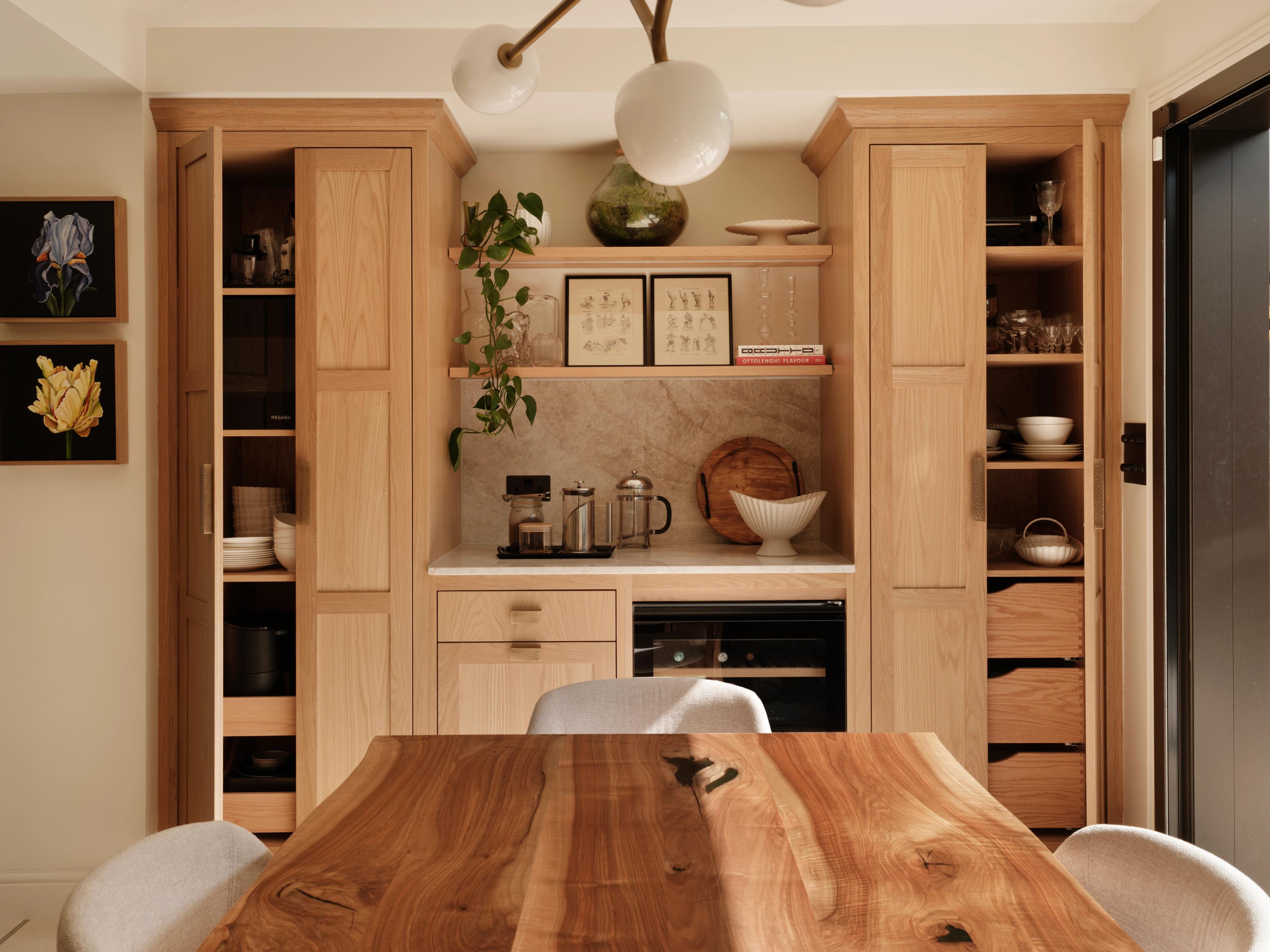
Lavender Hill: in-frame Shaker cabinetry in Night Sky, warmed by unstained oak.
The best pantry ideas are less about how much you can fit in and more about what you want to see every day. Whether it sits behind a door or you walk into it, a good pantry is organised around your mornings, your cooking and the route people take through the room.
Most kitchens have a moment every morning when they fall apart a little. The kettle is on, the toaster is out, someone is looking for the peanut butter and there is a coffee machine taking up the one bit of worktop you actually need.
A pantry is where that moment gets tidied away. Not by hiding more tins, but by giving the things you use every day a proper place to live.
At Naked Kitchens, we tend to see pantries fall into two shapes and two jobs. The shape is either a pantry behind a door or a walk-in pantry. The job is usually a breakfast station or a chef's pantry, though it doesn't have to be. Getting those two decisions right matters far more than the number of shelves.
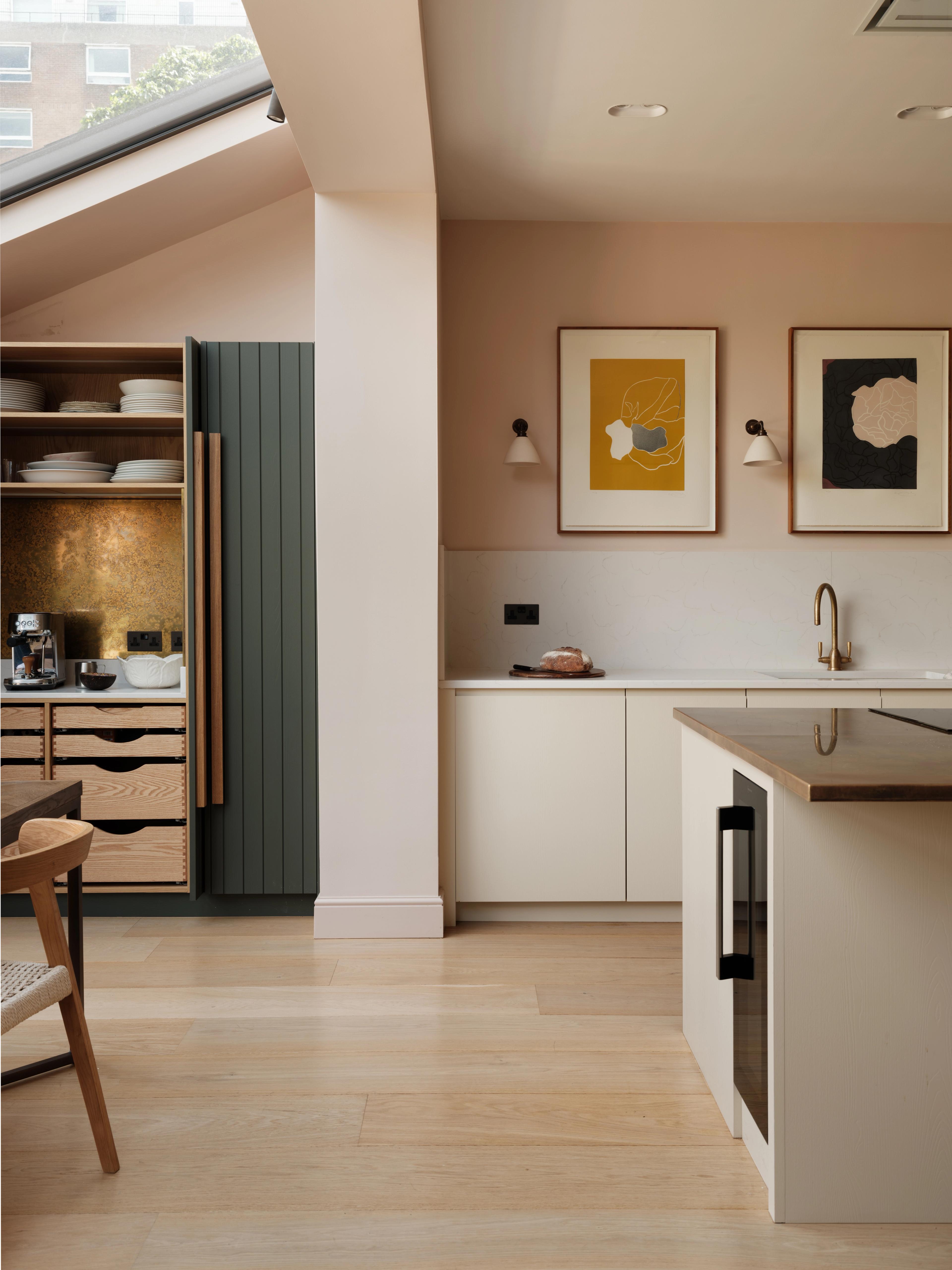
Sands End: the appliances live behind the tall cabinetry, so the kitchen stays open and sociable.
Behind a door or walk-in: which pantry suits your kitchen?
A pantry behind a door is a tall run of cabinetry that opens to reveal shelves, drawers and racks. Close the doors and it reads as part of the kitchen. It suits most rooms, because it needs no more floor space than a bank of tall cupboards.
A walk-in pantry is a small room of its own. It holds far more, it can take the bulk buys and the big platters, and nobody sees it unless they go looking. The trade-off is space. You need somewhere to put it and a doorway that doesn't fight with the rest of the room.
The question to ask is not which looks better. It is how much you keep, and how often you reach for it. A household that shops weekly and cooks most nights will fill a walk-in happily. A couple who mostly need somewhere for breakfast things may find a well-planned pantry cupboard does the job better, and closer to hand.
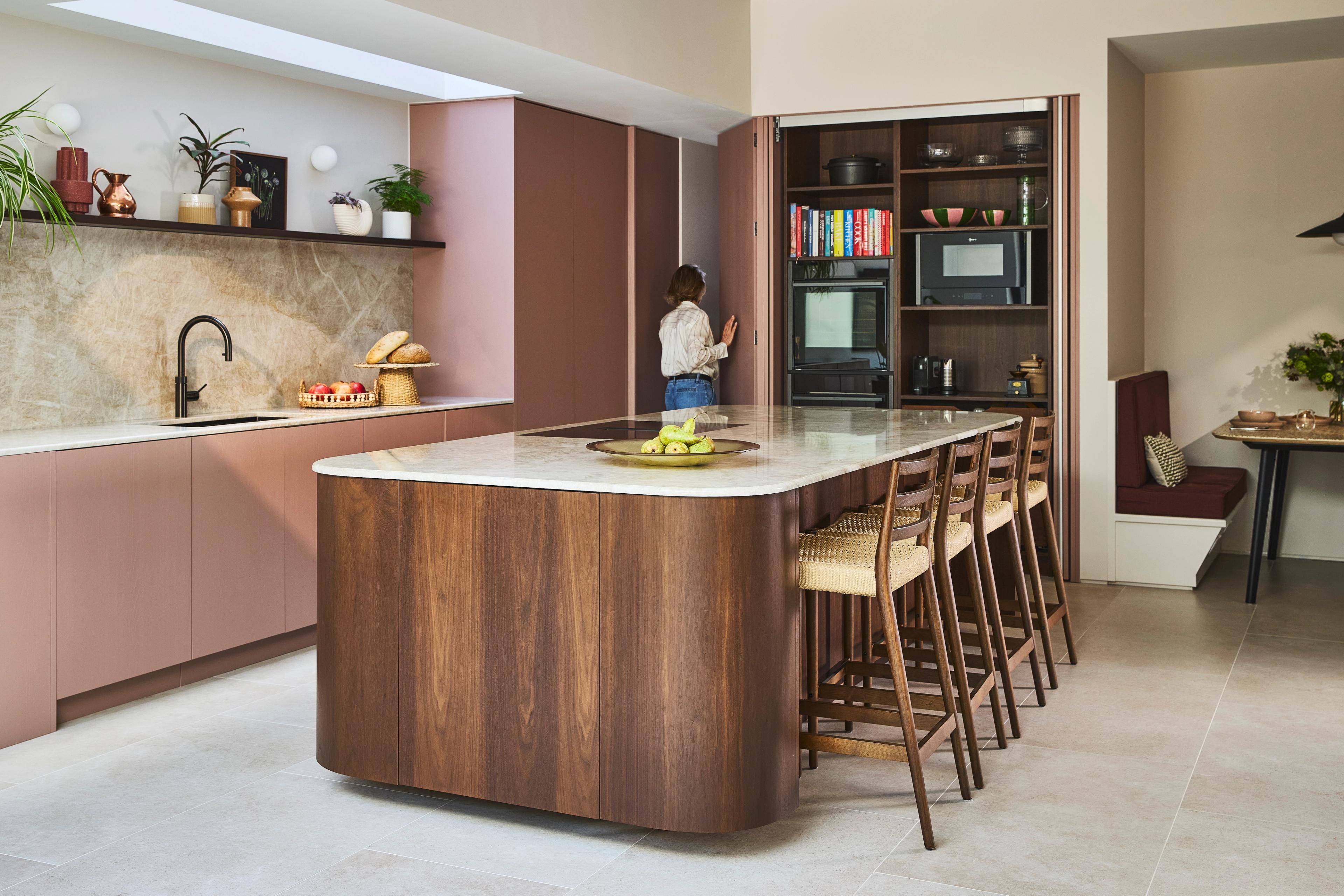
Grove Park: a door off the kitchen leads into a walk-in pantry and wine room, so the bulk storage and the bottles have a room of their own.
The breakfast station: building the pantry around the kettle
This is where pantries have changed most. Many people now use them as a breakfast or coffee station, with the internals built around the coffee machine, the toaster and the kettle.
It makes a lot of sense. Those are the appliances that live on the worktop, get used every morning and never quite look tidy. Put them inside a pantry with their own surface, power and storage for mugs, cereal and coffee beans, and the morning routine happens in one place. When you are done, the doors close on it.
The detail is what makes it work. Appliances need sockets in the right place, a surface that can take a spill and room for heat and steam to escape. None of that can be added neatly afterwards, so it belongs in the first design conversation.
In Sands End, the breakfast pantry sits under the slope of the roof. Open the doors and there is a worktop with its own sockets for the coffee machine, lit oak shelves for plates and glasses, and eight dovetailed oak drawers below. An aged brass splashback catches the light. Close the doors and the kitchen goes back to being open, bright and sociable.
Tip: list everything you make before 9am. That list is the brief for your breakfast pantry.
The chef's pantry: storing a lot and finding it fast
Others see the pantry as a chef's pantry. This is the working store: oils and vinegars, flours and grains, tins, spices and the ingredients for whatever you cook most.
Here, capacity matters, but only if you can see what you have. Drawers are the answer for anything heavy or bulky, because they bring the back of the shelf to you. Spice racks, on the inside of a door or on a shallow shelf, stop the jars disappearing behind each other.
In the Raynham kitchen, engraved drawer boxes for snacks, biscuits and bread sit alongside spice racks and wicker pull-out baskets. Everything has a place, so everything goes back.
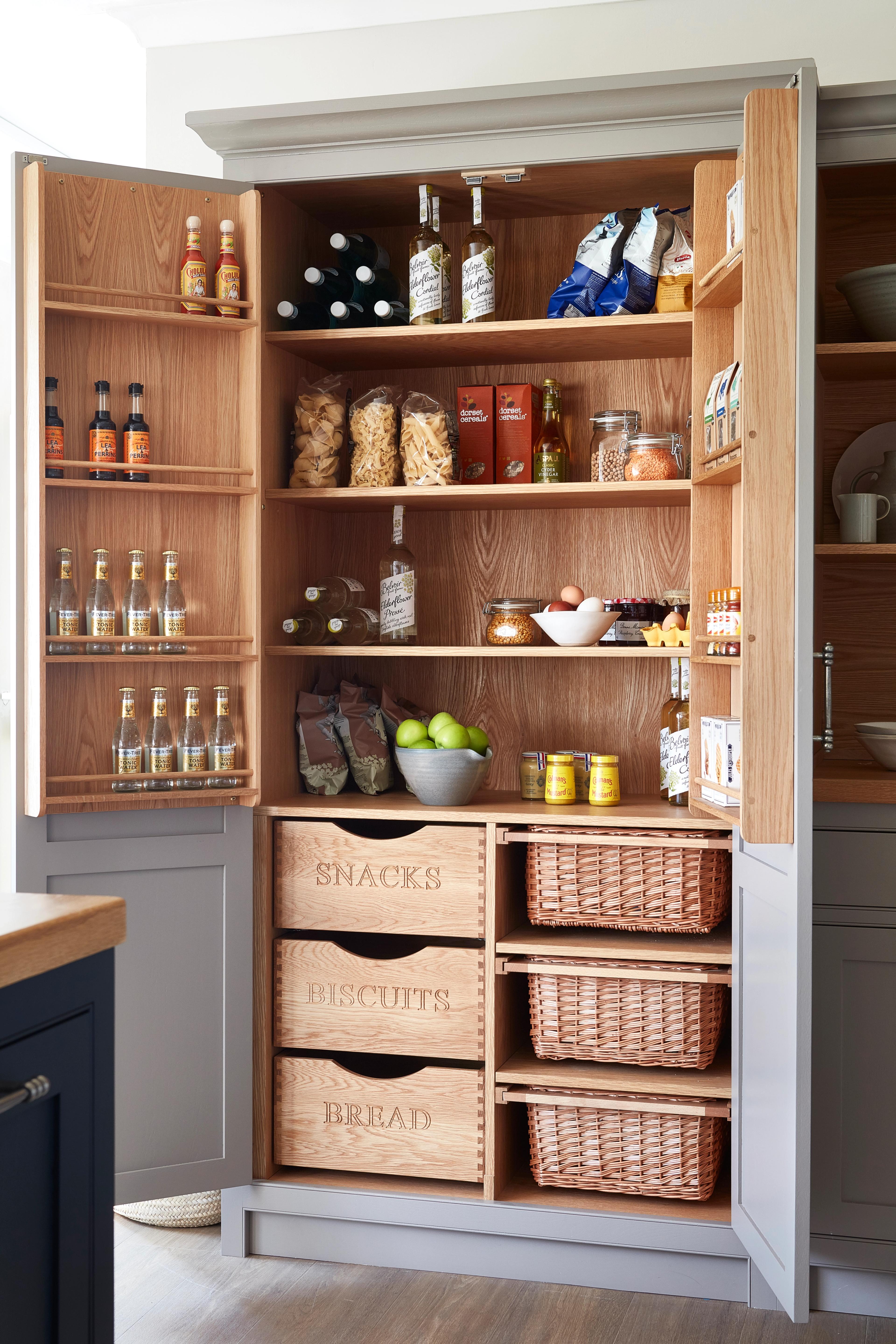
Raynham: engraved drawer boxes for snacks, biscuits and bread mean everything has somewhere to go back to.
Beyond breakfast: the baking pantry and the wine room
A pantry doesn't have to revolve around the kettle. Some of the best are built around one thing the household loves doing.
A keen baker might want a worktop to weigh and mix on, flours and sugars in deep drawers, and tins and trays stored upright so they slide straight out.
Others become a wine room. In Grove Park, the pantry sits behind the scenes and pairs generous worktop space and open shelving with a bespoke wine rack across the back wall. The rack is dark timber, echoing the kitchen island, so the bottles become the display. Baskets, jars and everyday essentials still have their place around it.
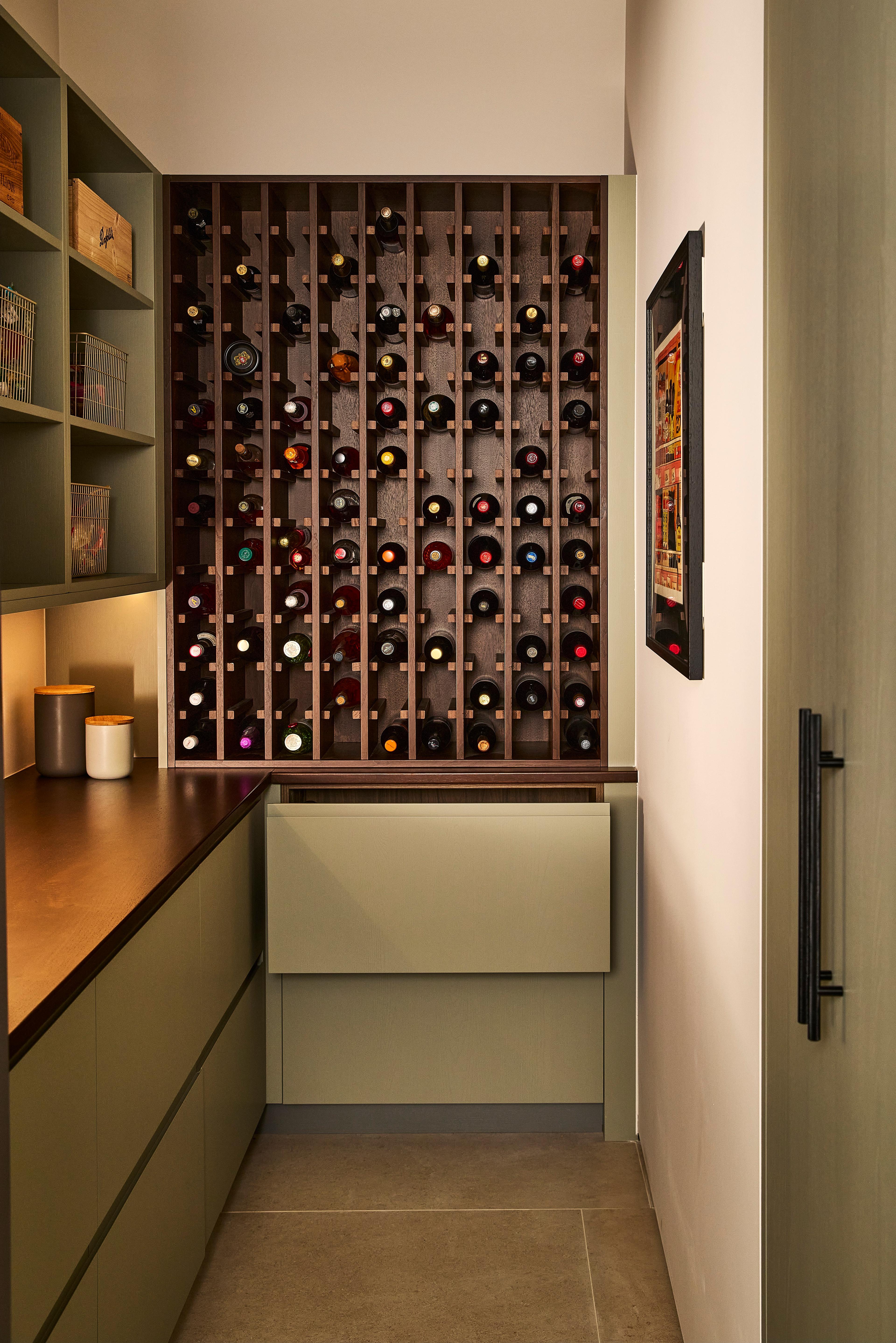
Grove Park: the walk-in pantry doubles as a wine room, with a bespoke dark timber wine rack across the back wall and room for the everyday things too.
The principle is the same as with breakfast. Decide what the pantry is for, and let that shape the inside.
Closed doors or reeded glass?
Once the inside is planned, the next decision is how much of it you want to show.
Closed doors hide everything. They suit a breakfast station full of appliances and a family that doesn't always put the lid back on the cereal. When they are shut, the pantry disappears into the cabinetry.
Reeded glass sits in between. It lets light through and hints at what is inside without showing every packet. In Southwold, reeded glass doors on a standalone cabinet give the pantry presence without turning it into a display. The honest caveat: glass still asks for a little order behind it.
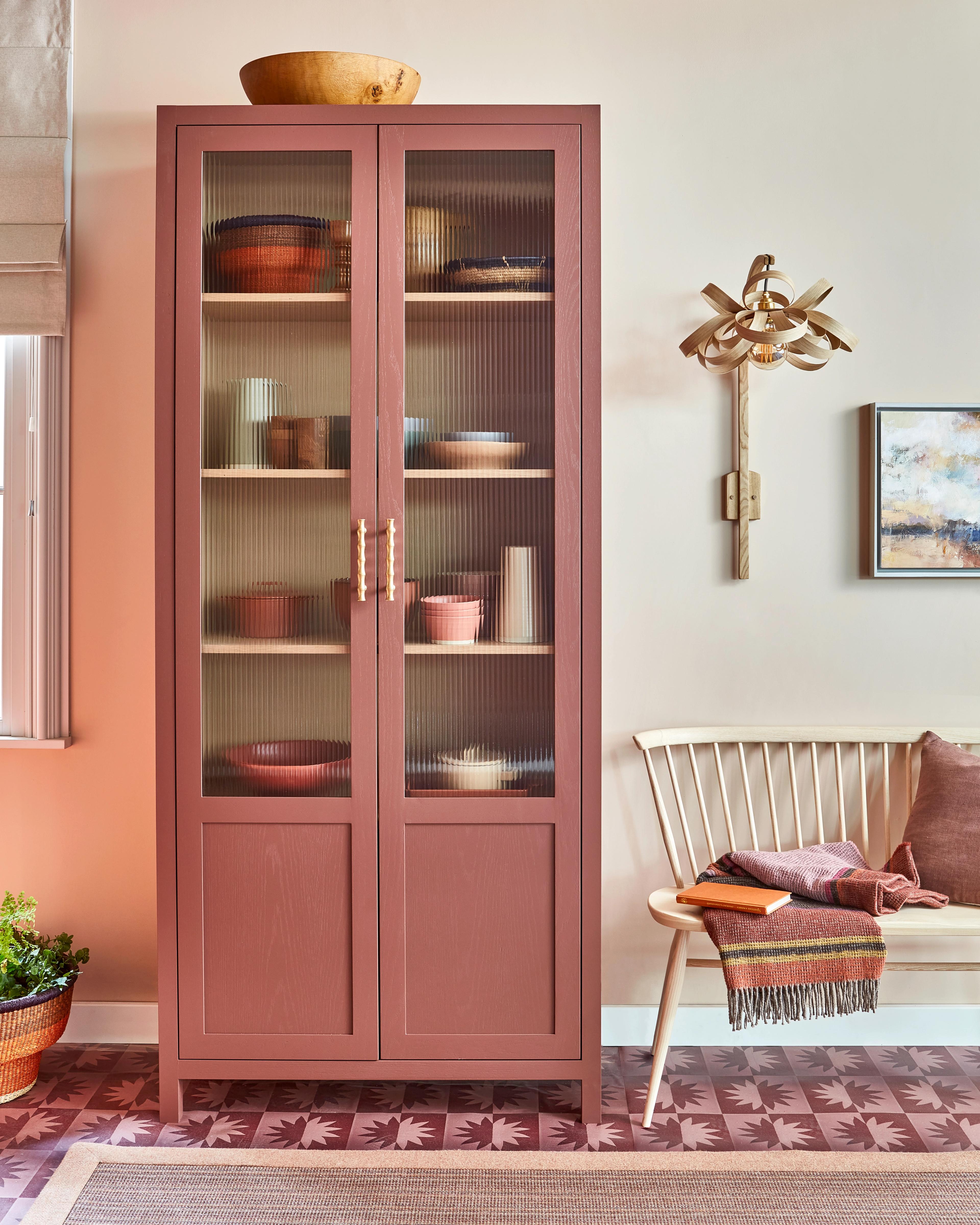
Harpley: a freestanding pantry cabinet with reeded glass and brass handles, so the essentials are on show without every packet on display.
Doors that stay open: pocket doors and bi-folds
The pantry that works hardest in the morning is the one you don't have to keep opening and closing.
Some people choose pocket doors, which open and then slide back into the sides of the cabinet. In Sands End, this means the breakfast pantry can stay open all morning without its doors sticking out into the walkway. Breakfast happens, people pass through, and nobody walks into a door.
You can see the same idea in our Cambridge showroom. A deep red pantry opens on pocket doors to oak shelves, a stone worktop for the toaster and two deep dovetailed drawers. The shopping bags live on the top shelf, which is exactly where they belong: out of sight, and easy to grab on the way out.
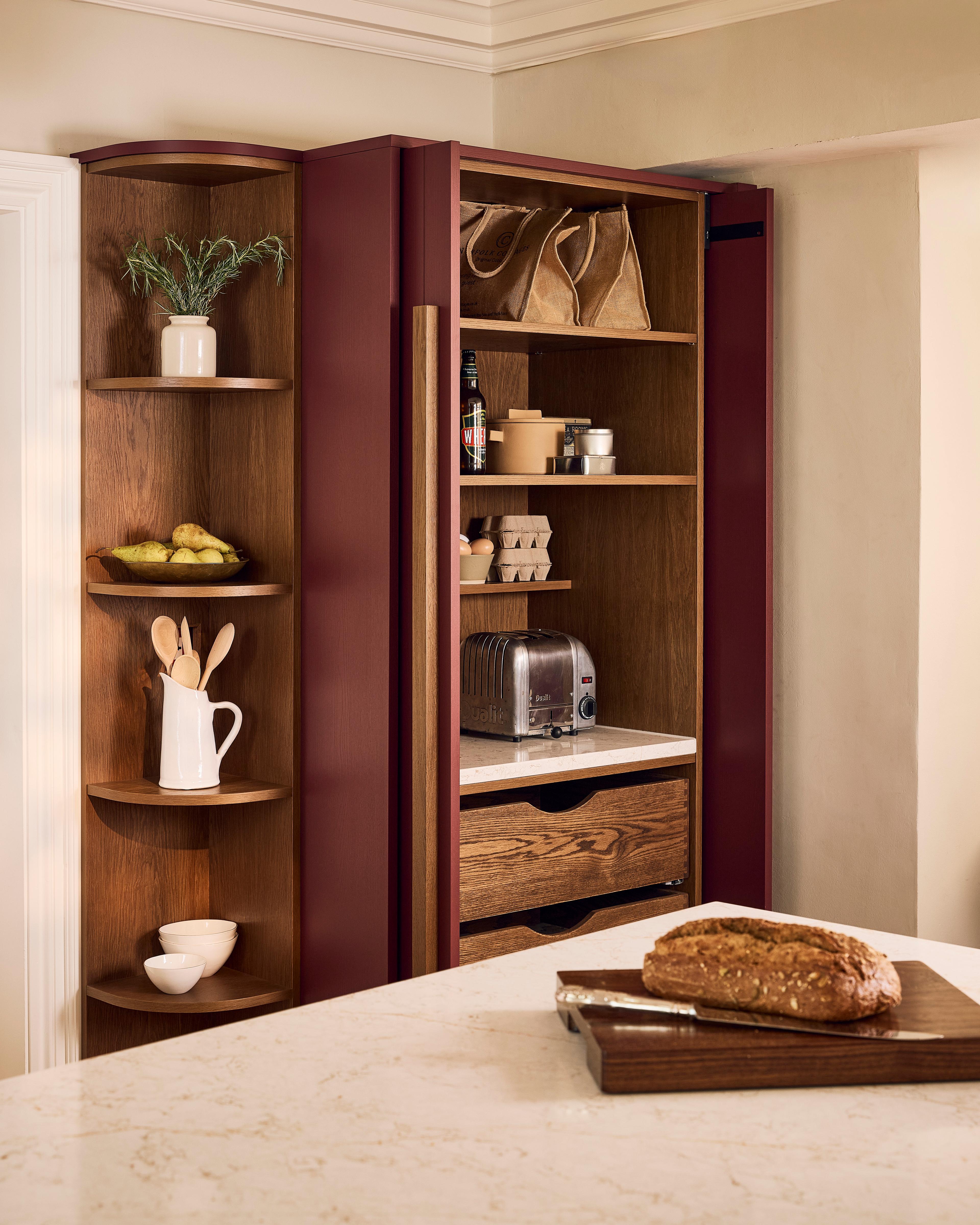
Madingley, in our Cambridge showroom: shopping bags on the top shelf, toast on the worktop, and pocket doors that slide out of the way.
Bi-fold doors, as in Chester Row and Cley, fold back on themselves and need less room to swing than a standard door. Both are worth considering wherever a pantry sits on a busy route.
How to organise a pantry so it stays organised
A pantry stays tidy when its layout matches how it is used. Organise by routine, not by category.
- Everyday at eye level. The things you reach for daily belong between shoulder and hip height.
- Heavy things low, in drawers. Flour, potatoes and bottles are easier to lift from a drawer than from a high shelf.
- Shallow where you can. Deep shelves hide things at the back. Shallow shelves and racks keep everything visible.
- Zones, not rows. Keep breakfast together, baking together and the weeknight basics together.
- Leave some room. A pantry that is full on the day it is fitted will be chaos in a month.
A pantry is a plan for your mornings
The best pantries are not the biggest. They are the ones planned around real routines: the first coffee, the school-run toast, the Tuesday night pasta. Decide what the pantry is for, then decide what it looks like.
If you would like to see a pocket door pantry in person, there is one in our Cambridge showroom. Our designers are also in Norfolk and Chelsea, and always happy to talk pantries.
Frequently asked questions
Can you put a coffee machine inside a pantry?
Yes, as long as it is planned from the start. It needs sockets in the right place, a surface that can cope with spills and space for heat and steam to escape. That is why appliance pantries are designed with the kitchen, not added later.
Is a walk-in pantry better than a pantry cupboard?
Not always. A walk-in holds more and hides more, but it needs floor space and a sensible doorway. A well-planned pantry behind a door can be more useful day to day, because it is closer to where you cook.
What doors work best on a pantry?
It depends on how often you open it. Pocket doors slide away so the pantry can stay open without blocking a walkway. Bi-folds need less room to swing. Closed doors hide everything, while reeded glass lets light through and softens what is inside.
What is the difference between a pantry and a larder?
The terms overlap, and today they are often used for the same thing. We explain the history and the modern difference in our guide to pantries, larders and utility rooms.
Request a Brochure
To receive a digital copy of our brochure and regular updates from us, please complete your details below.